Greed and the desire for power
The OutlawsGreed and the desire for power are expressed through the contest over the Diamond M and the county institutions too weak to contain it. Max Landon wants control of the ranch so intensely that he behaves as though it already belongs to him, while Red Muldoon’s fear that the enterprise might lose its profitability and prestige shapes the terms of his will. Against both men’s assumptions, Kate Muldoon asserts her right to inherit and take part in running the ranch. The book connects personal ambition to a larger landscape of abandoned mines, depleted public revenue, and authority concentrated in a powerful ranching interest.
A County Shaped by Decline
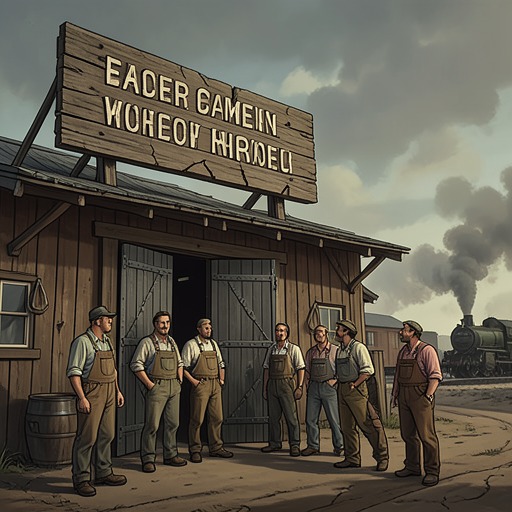
Roily’s setting makes the economic stakes visible. When Del Delaney and his companions arrive, the county seat looks more like a ghost town than a living center: empty log cabins have broken windows and askew doors, business buildings stand boarded or padlocked, and the remains of mills and mine dumps mark the mountainsides. A few officials and their clerks appear to be among the town’s remaining residents. The landscape records an earlier period of mining activity, but it also shows that the wealth once generated there has not secured the county’s present stability.
The bartender recalls silver still in the mines, but says extraction needs a market to become worthwhile. Roily now depends on a few cattle outfits and a little dry farming, rather than the bustle of its boom years. The gap between remembered prosperity and present scarcity is more than atmosphere: Judge Bailey explains that mines no longer provide taxes, some local property owners do not pay, and the county sometimes cannot pay its officials promptly. Even courthouse staffing has contracted from two janitors to none. The county’s financial weakness limits what its institutions can do, leaving the sheriff’s enforcement of the law essential to the judge’s ability to make rulings matter.
Red Muldoon had once helped sustain local authority by backing the sheriff and pressing him to act when he failed to do his job. As his health worsened, he could no longer leave the house, and Max began running the Diamond M. This transfer matters beyond the ranch: the county has few sources of revenue, and its officials have limited means to check a powerful landowner. Max’s influence consequently rests both on his own methods and on a local structure in which economic strength can carry political weight.
Max Landon’s Ambition
The people who know Max describe his power as deliberately exercised. The cook, Bill Rogers, says Max is intelligent about managing people, choosing whom to threaten and whom to favor. Rogers also describes him as willing to lie, exploit another person’s weakness, and force aside anyone who obstructs him. In his assessment, Max has no apparent conscience. These observations present ambition not simply as a desire for wealth, but as a practical method of gaining control through manipulation and intimidation.
Max’s treatment of Kate reveals the personal and economic dimensions of that ambition. Kate says he has pressed her to marry him since she was fifteen. She never wanted the marriage, and told Red she would kill herself if he forced it; Red did not press her, though he continued to want the match. Kate had also suspected Max of robbing her father but lacked proof, while Red trusted him and believed he could do no wrong. Rogers later suggests that Max’s resentment of Kate’s rejection would give him a reason to want her dead even apart from his interest in the ranch.
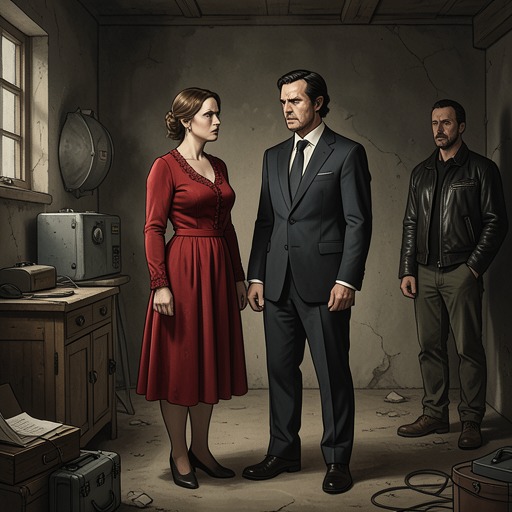
Adam Jessup, the banker, recognizes a related sign of Max’s presumption: Max has sought loans to improve the Diamond M herd as if the ranch were already his, and brushed aside the requirement that he deal through Kate. Jessup had considered Max reasonably rational, but his conduct suggests an obsession with ownership. At the reading of the will, Max objects to Del Delaney’s presence, claiming he has no right to be there. Kate answers that Del has every right to remain and says they will soon marry. Max’s disbelief that she chose Del over him exposes his expectation that her choices, and the property attached to them, should conform to his claim.
Red Muldoon’s Will and the Ranch
Judge Bailey explains that Red’s will was shaped by an intense fear that the Diamond M would cease to be a visible ranch: an operation that made a profit and gave its owner power and prestige. In a small, poor county, Bailey says, those qualities were linked, particularly for an ambitious and aggressive owner. Red believed Max possessed the qualities to preserve that standing. His plans therefore joined the ranch’s financial success to a wider vision of authority, and treated Max as the man capable of sustaining both.
That vision rested on Red’s assumptions about gender. Kate recalls that her father loved her, took her hunting and fishing, and tried to treat her like a boy, but believed he had given Max the love he would have given a son. She understands Red to have wanted her to marry Max so that Max would continue running the ranch—and, in her view, effectively own it under laws and customs that disadvantaged women. Red was proud of the Diamond M and did not think a woman could manage it. Bailey likewise acknowledges that Red did not see women as aggressive. The will’s provisions thus make Kate’s inheritance conditional in a revealing way: she receives the estate, but if she dies it passes to Max.
The will turns Red’s fear of losing the ranch’s status into a source of danger. Max seems to have expected to receive the estate, and his confidence is consistent with his treatment of the Diamond M as his already. After the will is read, Kate recognizes that its death provision helps explain why Max has been so anxious to kill her. Jessup observes that what happens is likely to affect the whole county, not only Kate or Del, because the ranch’s ownership is bound up with local power. The will preserves the possibility of the ranch’s continuity, but gives Max a direct financial interest in Kate’s death.
Wealth, Risk, and the Meaning of a Dream
The abandoned Enterprise Mine provides a counterpoint to the ranch’s struggle for control. Its buildings are damaged by years of neglect: windows are broken, doors sag, machinery rusts, and roofs have collapsed under winter snow. Delaney sees the scale of the scattered machinery and buildings as evidence of the large hopes once invested there. Kate recalls that her father said the owners spent more than a million dollars developing the mine. He did not know how much silver they found, but the company went broke, leaving Eastern investors with losses; Kate had heard stories of widows and elderly people losing their life savings.
John Smith calls such investment greed, then revises the argument toward gullibility: in his view, no one should invest in a mine without being able to afford losing the money. Kate resists that judgment. She argues that people living in poverty might invest not out of simple avarice but because they see a chance to escape hardship. Smith distinguishes those hopes from a sound financial decision, but his own history complicates his certainty: he admits that he once invested his life, rather than money, in a dream and considers himself gullible for doing so. The exchange refuses to make every desire for a better life equivalent to Max’s possessive ambition. A dream may expose someone to loss, yet the desire behind it can arise from deprivation rather than a wish to dominate others.
Kate’s Claim to Authority
Kate’s response to the will is practical as well as personal. Earlier, when Del asks whether she knows what it contains, she says Judge Bailey would not tell her, though he called it a bad will and had tried to persuade Red to change it. She believes her father respected blood relationships, but also expected her to marry Max and leave him in control. Her account shows how affection and exclusion coexist: Red loved his daughter, yet his picture of who could exercise authority on the ranch remained male.
Kate eventually states that she and Del will marry, and insists that he belongs in the room for the will’s reading. Later, after the conflict over the estate, she says they must learn how to run a ranch and that she plans to place most of the responsibility with her foreman. She adds that marriage will not exempt Del from that work. Her plan asserts managerial judgment without suggesting that she must perform every task herself; delegating responsibility is part of her intended stewardship. The novel thereby sets her exercise of authority against both Red’s assumption that a woman could not run the ranch and Max’s assumption that the ranch was his to command.
The contrast also clarifies the concept’s stakes. Max’s power is acquisitive: he treats the ranch, Kate’s future, and the county’s deference as things to secure for himself. Kate’s claim is tied to inheritance and the work of governing the property, while Red’s concern for the Diamond M’s visibility links profit to prestige and local influence. In a county diminished by the collapse of mining revenue, these are not separate contests. Control of the ranch can determine who holds practical authority, while the weakness of public institutions makes the difference between legal entitlement and enforceable power especially consequential.